Why crestron is the right solution for your home
Why Crestron: What Makes It the Right Platform for Luxury Home Automation
We’ve been a Crestron dealer for years. In that time we’ve evaluated other platforms, installed a few of them on projects where the scope called for it, and consistently come back to Crestron as the default recommendation for serious luxury residential installations. This article is the honest account of why that hasn’t changed – and why the reasoning holds up even as the competition has improved.
Full disclosure upfront: we are Crestron integrators based in South Florida. We believe in the platform and work with it daily. What follows is not a marketing piece – it’s a practical explanation of what Crestron does better than the alternatives, and where those differences actually matter to a homeowner or design professional making a specification decision.
A Brief History Worth Knowing
Crestron was founded in 1971 by George Feldstein, an American engineer who patented more than 14 inventions that shaped modern home automation. More than 55 years later, the company is still manufacturing in the United States – an operational choice that has implications for product quality, supply chain reliability, and the kind of institutional continuity that matters when you’re specifying a platform that’s supposed to run a home for 20 years.
Crestron now manufactures over 3,000 products, holds hundreds of patents, and operates across residential, commercial, government, and educational markets worldwide. That breadth of deployment is relevant – it means the platform is tested against an enormous range of real-world conditions, not just the residential use cases it’s marketed for.
What Crestron Does That Others Don’t
Infrastructure Built to Last
Crestron’s proprietary CresNet wiring protocol uses military-grade certified cable and connectors designed for bidirectional communication across lighting, keypads, shade motors, sensors, and control devices. The infrastructure is engineered with an 80-year performance expectation – not a marketing claim, but a specification that reflects how the platform is actually built.
In practical terms, this means a Crestron infrastructure installed during a home’s construction will still be fully functional and expandable decades later. Technology changes. The control platform evolves. But the physical infrastructure doesn’t need to be replaced every time the homeowner wants to add a system or upgrade a component. For a waterfront estate in Coral Gables or a multi-building property in Palm Beach, that long-term reliability is a real consideration – not an abstract one.
True Whole-Home Integration
Crestron integrates natively with virtually every major system category: lighting control, motorized shades, distributed audio and video, HVAC and climate, security and surveillance, access control, and network infrastructure. That’s not unusual for a home automation platform. What is unusual is the depth of those integrations and the breadth of third-party compatibility.
Crestron maintains direct integrations with thousands of devices and systems – from enterprise HVAC platforms to marine vessel systems to commercial building management infrastructure. For a South Florida estate with a yacht, a guest house, a wine cellar, and a home theater, having a single control platform that manages all of it without bridging or workarounds is a meaningful operational advantage.
Crestron Home – The Residential Platform

Crestron Home is the company’s current residential platform – and it’s worth addressing directly because it changed what Crestron looks like for homeowners. Earlier Crestron residential installations required significant custom programming, which meant longer timelines and higher costs for straightforward projects. Crestron Home shifted that model: it’s a configured platform with an interface designed by Apple, available on iOS and Android, that handles typical residential automation without the programming overhead of a fully custom system.
For projects that do need deep customization – unusual control logic, complex integrations, large estates with specific operational requirements – Crestron’s full programming environment is still available and handles it in ways no consumer platform approaches. Crestron Home is the starting point. Custom programming is the ceiling, and that ceiling is very high.
For current 2026 pricing on a Crestron Home build in South Florida — tier ranges, where programming cost actually sits, and how partial-area scoping keeps the budget in check — read our Crestron smart home cost guide.
Hardware That Belongs in a Luxury Home
The control interfaces matter as much as the platform itself in a high-end residential installation. Crestron’s Horizon line of dimmers and keypads has a minimal, architectural profile – flush to the wall, no visible screws, available in a range of metal finishes that coordinate with plumbing hardware and door hardware throughout the home. Engraved labels, custom button configurations, finishes specified by the interior designer – these are not afterthought details. They’re the difference between a keypad that looks like it belongs in a $5 million home and one that looks like it was added after the fact.
The Cameo line offers similar flexibility with a slightly different profile. Crestron touchscreens, remote controls, and mobile interfaces follow the same design discipline – hardware that’s been thought about as carefully as the technology behind it.
Scalability Without Starting Over
A Crestron system installed in a home today can be expanded, reconfigured, and updated without replacing the core infrastructure. New rooms, new systems, new integrations – these are programming and hardware additions, not infrastructure replacements. For homeowners who renovate, add outbuildings, or want to incorporate new technology as it becomes available, that scalability is a practical advantage that compounds over time.
It also matters for resale. A home with a documented, professionally installed Crestron system – with organized rack infrastructure, labeled wiring, and transferable programming files held by a certified dealer – is a different asset than a home with a collection of consumer smart devices that may or may not work together.
Where Crestron Makes the Most Sense
Crestron is not the right answer for every project. A small condo or a single-system installation may be better served by a simpler platform. What Crestron does best is complex, multi-system integration at scale – the kind of project where the number of devices, the depth of integration, and the long-term reliability requirements justify the investment in a professional-grade platform.
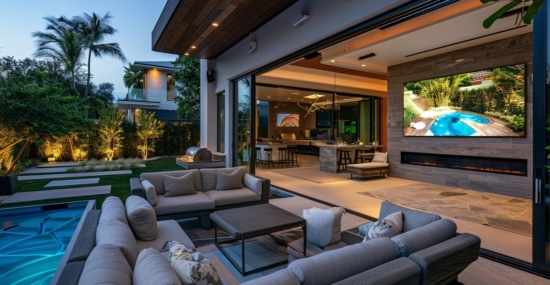
In South Florida’s luxury residential market, that describes most of the projects we work on. Large waterfront estates, multi-building properties, homes with significant outdoor living scope, and residences where the technology infrastructure is expected to perform at the same level as everything else in the house – these are Crestron projects.
For a closer look at how Crestron compares to Savant – the other premium residential platform we’re asked about most often – our Savant vs Crestron comparison covers the differences honestly. And for the lighting control side specifically, our wired vs wireless smart lighting guide explains how Crestron’s lighting platform fits into the broader decision.
Working with a Certified Crestron Dealer
Crestron distributes exclusively through certified dealers – which means the dealer relationship is part of what you’re buying. A certified dealer designs the system, selects hardware for the specific installation, handles programming and commissioning, and holds the project files for future updates and expansions. When something needs to change two years down the road, the dealer has the credentials and the documentation to do it cleanly.
Geeks of Technology is a certified Crestron dealer serving luxury residential clients across Miami-Dade, Broward, and Palm Beach. We work directly with homeowners, architects, interior designers, and builders from early design through long-term support. Visit our Crestron brand page to learn more about what we offer, or see our integrated home automation services for a full picture of what a Crestron installation involves.
Start the Conversation
If you’re building, renovating, or evaluating control platforms for a South Florida residence, we’re happy to walk through what Crestron looks like for your specific project – scope, budget, timeline, and how it coordinates with the rest of the design team.
Call us at (954) 251-0600 or visit our contact page to get started.
You might also enjoy