
Philips Hue vs Lutron for Luxury Homes | Geeks of Technology
Philips Hue is one of the most recognizable names in smart lighting. It’s well-made for what it is, easy to set up, and works reasonably well in a straightforward application. For a vacation rental, a starter apartment, or a secondary residence where expectations are modest, it does the job. For a luxury home — one where the lighting system is a meaningful part of the architecture, the interior design, and the daily experience of living there — it falls short in ways that matter. Here’s why.
What Philips Hue Actually Is
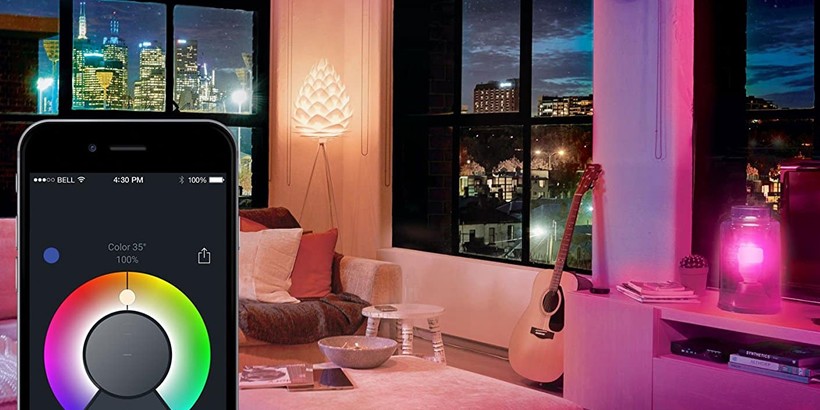
Philips Hue is a consumer smart lighting platform built around replaceable bulbs and a bridge device that communicates over Zigbee. You screw bulbs into existing fixtures, connect the bridge to your router, and control everything through the Hue app. Color changing, dimming, scheduling, and basic automation are all available. It works with Alexa, Google Home, and Apple HomeKit.
That’s the ceiling. Hue is designed to be installed by a homeowner in an afternoon without any professional help. That design philosophy — simple, accessible, DIY — is also the source of every limitation that makes it unsuitable for a serious luxury installation.
The Dimming Problem
Dimming quality is one of the most immediately noticeable differences between consumer and professional lighting platforms. Philips Hue bulbs use PWM (pulse-width modulation) dimming, which creates an invisible flicker at low light levels. Most people don’t consciously notice it, but it contributes to eye fatigue in spaces where you spend extended time — a living room, a study, a bedroom. It also means Hue cannot dim smoothly to very low levels without visible stepping or color shift.
Lutron’s professional platforms — Homeworks QSX and RadioRA 3 — use a fundamentally different dimming architecture. Lutron’s Hi-lume and EcoSystem dimmer technology produces smooth, flicker-free dimming from 100% down to less than 0.1% without color shift. In a room with architectural lighting designed by an interior designer, that difference is visible and significant.
The Integration Problem
In a Philips Hue installation, the lighting system is its own island. It connects to voice assistants and some third-party platforms, but it does not integrate at a native level with a professional control processor. You cannot include Hue in a true whole-home scene that simultaneously adjusts shading, climate, AV, and security. You can approximate it through workarounds, but the result is unreliable and requires ongoing maintenance as firmware updates on any of the platforms break integrations.
Lutron’s Crestron lighting design and controls integration is native and bidirectional. The Crestron processor communicates directly with the Lutron processor — not through a consumer API that can change without notice. A “Good Morning” scene that raises the shades, adjusts the thermostat, starts music in the bathroom, and brings the bedroom lights to a warm 2700K at 30% is a single command to the Crestron system. Every element responds together, reliably, every time.
The Fixture Problem
Philips Hue is built around its own bulbs. Your fixtures must accept Hue bulb form factors, which limits your options significantly on the architectural lighting side. Custom fixtures, recessed trims, linear systems, cove lighting, and landscape fixtures that a lighting designer would specify for a luxury home are not compatible with the Hue ecosystem. You are choosing your lighting architecture around a bulb format rather than choosing the best fixture for each application.
Lutron’s platform is fixture-agnostic. It controls any dimmable load — LED drivers, 0-10V ballasts, phase-dimmable fixtures, EcoSystem digital fixtures — regardless of manufacturer. The lighting designer specifies the right fixture for each position in the home. Lutron handles the control layer without constraining those choices.
The Reliability Problem
Consumer smart home devices depend on cloud infrastructure and consumer-grade wireless networks. When Philips’ cloud has an outage, or when your router firmware updates and drops the Hue bridge from the network, or when a bulb falls off the Zigbee mesh because someone moved a piece of furniture — the system stops working until someone troubleshoots it. In a luxury home, that’s not acceptable.
Lutron’s ClearConnect RF protocol operates at 434 MHz, well away from the congested 2.4 GHz band. It doesn’t route through a cloud server. It doesn’t depend on your home’s Wi-Fi network. The system processes commands locally, responds in under 300 milliseconds, and continues to function during internet outages. Lutron lighting control in Miami installations we’ve commissioned have operated without intervention for years — which is what a luxury installation should do.
What a Professional Lighting System Looks Like
A professionally designed lighting system for a luxury home starts with a lighting designer specifying fixture placement, beam angles, color temperatures, and layering for each space. The Lutron platform is selected for its dimming performance and reliability. Crestron integrates the lighting layer with shading, climate, AV, and access control into a single unified system. The homeowner interacts with a keypad or a touchscreen — or doesn’t interact at all, because the system responds to time, occupancy, and natural light automatically.
It costs more than Philips Hue. It also performs and lasts in ways that Philips Hue does not, and it does not require the homeowner to troubleshoot it. For a home where the lighting is a meaningful part of the design, that difference is the right investment.
If you’re evaluating lighting systems for a new build or renovation and want to understand the practical differences between consumer and professional platforms, our team is available for a direct conversation. You can also read more about wired vs wireless smart lighting to understand the infrastructure considerations behind the platform decision.
Call us at (954) 251-0600 or use the contact form.
You might also enjoy


