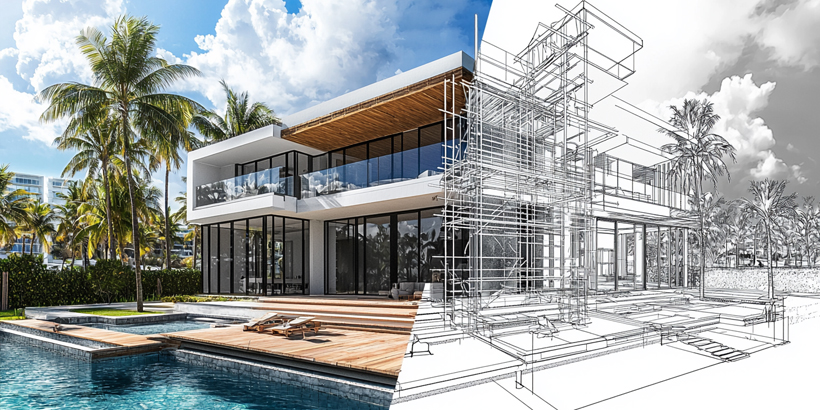
Smart home integration tips for Miami architects & designers
What Miami Architects and Interior Designers Should Know About Smart Home Integration
Miami’s high-end residential market is where much of our work happens – and the projects that go smoothest are almost always the ones where the architect or interior designer called us before the permit set went out. See how we approach smart home installation in Miami projects from the design phase forward.
The ones that don’t go as well follow a predictable pattern: technology gets specified late, infrastructure decisions get made without an integrator at the table, and by the time we’re brought in, the ceiling is in, the walls are closed, and the options have narrowed considerably. What should have been a clean installation becomes a series of compromises.
This article is written for architects and interior designers who want to avoid that pattern. Not a product pitch – a practical look at what technology coordination actually requires at each phase of a luxury residential project in Miami.
Why the Timing of the Technology Conversation Matters
The decisions that most affect how a technology system performs are not technology decisions. They’re architectural ones. Ceiling depth determines whether a shade pocket is possible. Wall assembly affects whether a speaker can recess cleanly or has to surface-mount. The location of the electrical room relative to the main living areas determines how far control wiring has to run and how the rack gets sized. None of these things can be fixed after the slab is poured.
When an integrator is involved at schematic design, those decisions get made correctly the first time. Conduit pathways get drawn into the plans. Ceiling heights get flagged where recessed equipment is planned. Equipment rooms get sized for what actually needs to go in them – not what someone estimated. The result is a home where the technology infrastructure is part of the architecture, not bolted onto it.
If you want to go deeper on the schematic design phase specifically, our guide on what architects need to know at schematic design phase covers the conversations we have with architects before a permit set goes out.
What Architects Need to Plan For
Structured Wiring and Conduit
Every connected system in a luxury home – lighting control, motorized shades, distributed audio, security cameras, access control – runs on structured cabling that has to get from a central wiring closet to every device in the home. In new construction, that means conduit pathways planned into the drawings, home runs pulled to the right locations, and a wiring closet or equipment room sized appropriately for the rack that’s going in it.
A good rule of thumb: plan for more conduit than you think you need, especially in concrete construction. South Florida’s block and poured concrete builds make wire fishing difficult after the fact. What costs a few hundred dollars to rough in during framing can cost thousands to address in a finished home.
Ceiling Depth and Recessed Equipment
Motorized shade pockets, recessed speakers, in-ceiling subwoofers, and flush-mount lighting fixtures all have minimum ceiling depth requirements. A standard drywall ceiling with 3.5 inches of depth won’t accommodate a motorized shade cassette for a 10-foot wide window. A barrel-vault ceiling in a Mediterranean Revival home needs to be assessed before a speaker gets specified.
These dimensions need to be in the architectural drawings before the ceiling framing is set. We provide a technology infrastructure document at the start of every new construction project that gives the architect and structural engineer exactly these requirements – rough-in dimensions, box locations, conduit entry points – formatted for inclusion in the construction documents.
Equipment Room Sizing
A large estate with Crestron automation, Lutron lighting, a distributed audio system, a home theater, enterprise networking, and full security integration needs a rack room – not a shelf in a utility closet. Equipment rooms for serious installations need adequate square footage, dedicated cooling, proper electrical circuits, and cable management pathways. These decisions belong at schematic design, not at construction administration.
Home Theater Planning
A dedicated home theater is one of the most infrastructure-intensive spaces in a luxury home. Conduit runs, acoustic wall details, ceiling height minimums, structural blocking for tiered seating, equipment room adjacency – all of it needs to be settled at the drawing stage. Conduit runs, acoustic wall details, and equipment room sizing all need to be resolved before the permit set goes out, which is why early conversations about home theater design and installation matter so much. A theater that gets designed after drywall is up will always be a compromise.
What Interior Designers Need to Know
Keypad and Control Interface Selection
Lutron, Crestron, and Savant all offer control keypads in a range of finishes – metal, custom colors, engraved labels. These are not afterthoughts. They sit on walls throughout the home alongside hardware, millwork, and finish selections that the interior designer has spent months coordinating. The technology interfaces need to be part of that conversation, not handed off to the integrator to specify independently.
Lutron’s Palladiom and Alisse keypad lines, for example, come in finishes that can be matched to plumbing hardware or custom painted to the wall color. Crestron’s Cameo and Horizon lines offer similar flexibility. Getting those selections right requires the integrator and the interior designer to be in the same conversation – not communicating through the general contractor after the walls are painted.
Fixture Compatibility with Lighting Control
Not every decorative fixture dims cleanly on every platform. The relationship between the control system’s dimmer and the fixture’s driver or transformer determines whether dimming is smooth or plagued by flicker and buzz. This is a compatibility question that needs to be answered before fixtures are ordered – not after they’re installed and the client is complaining about the behavior.
When interior designers share fixture specifications early, we can flag compatibility issues before they become field problems. In many cases the fix is simple – a different driver, a specific dimmer module. In some cases the fixture needs to change. Either way, it’s a much easier conversation at design development than at punchlist.
Shade Pocket Coordination
Motorized shade pockets are an architectural element that lives at the intersection of the interior design and the technology scope. The fabric selection, the cassette profile, the fascia detail, the hem bar weight – these are interior design decisions. The pocket depth, the wiring entry point, the motor type – these are technology decisions. Both need to happen in coordination, and both need to be resolved before the ceiling goes in.
We work directly with interior designers on shade specifications – reviewing fabric samples, advising on openness factors by exposure, and coordinating with the architect’s team on pocket sizing. The earlier that conversation starts, the more options remain open.
Wellness, Circadian Lighting, and Sustainable Design
Miami’s luxury homeowners increasingly expect their homes to perform efficiently and support how they actually feel day to day – not just look the part. Occupancy sensors, daylight harvesting, and energy monitoring dashboards are now standard requests on serious projects.
Circadian lighting is one of the faster-growing requests we see from architects working with wellness-focused clients. Ketra tunable-white fixtures, integrated with Lutron HomeWorks or Crestron, shift color temperature and intensity throughout the day – warmer in the morning and evening, cooler and brighter midday – following patterns that support natural sleep and alertness cycles. Air quality monitoring, ERV integration, and automated ventilation responses to CO2 levels fall into the same category. These are systems with real rough-in requirements that need to be committed at schematic design, before the walls close. Our circadian lighting and wellness technology systems service covers the full technical spec for architects working through that coordination.
Coordinated lighting control, automated shading, and HVAC integration working together can reduce energy consumption in a large South Florida home by 30 to 50 percent compared to conventional systems. That’s a number worth putting in front of a client during schematic design – because it’s a number that changes how they think about the technology budget.
Modular and Pre-Configured Systems for Multi-Unit Projects
For architects and developers working on luxury condos or multi-unit residential projects, modular technology packages – pre-configured AV racks, standardized wiring bundles, consistent control platforms across units – can significantly reduce installation time and improve quality consistency across the building. We’ve helped developers and their design teams standardize technology specifications for high-rise projects in Brickell and along the Intracoastal, where unit count makes consistency a real financial consideration.
How to Work with Us
The most productive integrator relationships for architects and interior designers start at schematic design and stay active through commissioning. We attend design coordination meetings, provide pre-construction documentation in formats the architect’s team can use, coordinate directly with the MEP engineers on electrical and conduit requirements, and stay available through construction administration when field conditions require decisions.
We don’t show up at rough-in with a box of wire and figure it out from there. The infrastructure planning happens at the drawing stage, which is what makes the installation go cleanly.
If you’re an architect or designer specifying technology for a client, our design partner program for architects and designers was built for exactly that relationship. It covers how we work together from early design through long-term client support.
Let’s Talk About Your Next Project
If you’re working on a luxury residential project in Miami and technology coordination isn’t yet part of the conversation, that’s the right time to reach out – not after the permit is pulled.
Call us at (305) 791-7001 or visit our contact page to schedule a project conversation or technology walk-through.
You might also enjoy


