Home Theater Installation in Miami and South Florida

A room built to disappear.
Darkness, sound, and seating engineered as one. Designed for homes across Miami, Fort Lauderdale, and Palm Beach.

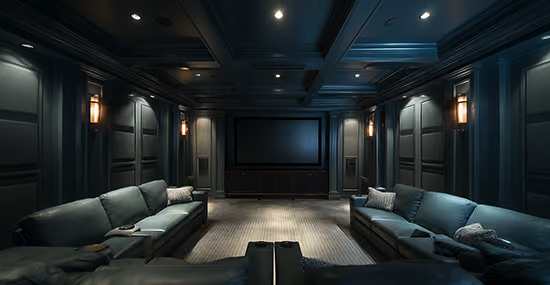
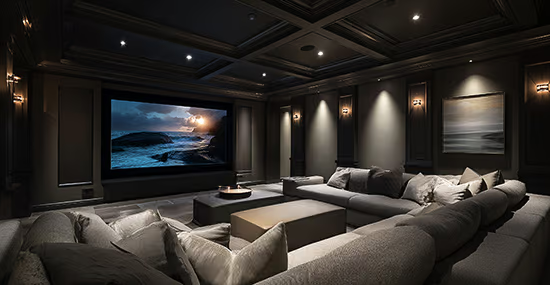
Home theater installation in a South Florida residence, designed for complete light control and cinematic focus.

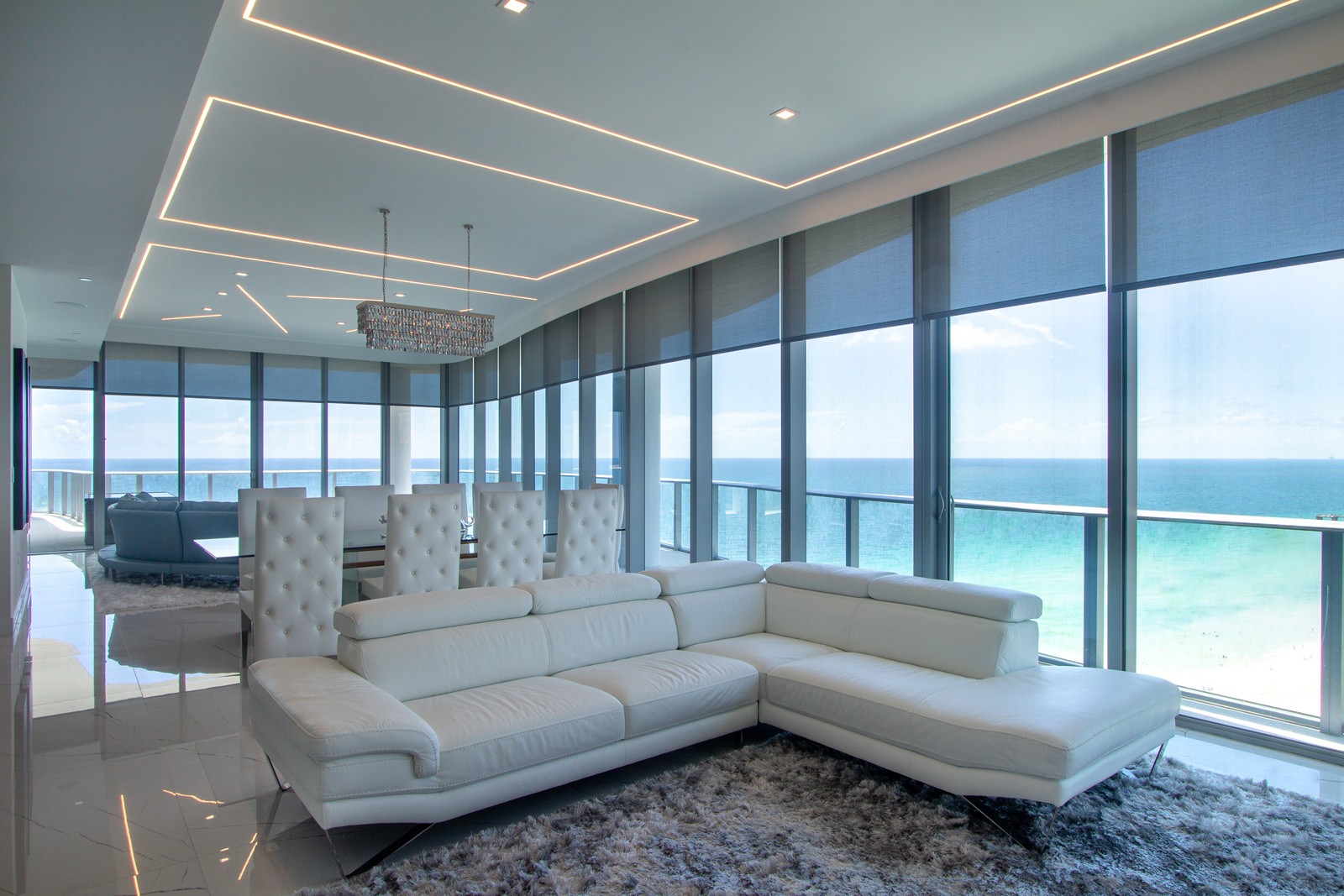
A true home theater begins with light control. No windows, or fully blacked-out windows, because any light hitting the screen lifts the black level and washes out the image. This matters more in South Florida than almost anywhere, since the daylight is intense and most homes are built to let it in. We handle it with motorized blackout shades, dark non-reflective surfaces, and placement that keeps every light path off the screen. If a room can't be fully darkened, that's a media room, and we'll tell you that up front. The full picture of how this connects to the rest of the home lives under our whole-home systems integration.

Frequently asked questions

How much does home theater installation cost in Miami?+

Four tiers cover most projects we build. A media room conversion with a large display, good audio, and basic lighting control runs $25,000 to $50,000 installed. A mid-range dedicated theater with a projector, 7.1 or Atmos audio, and acoustic treatment in a 250-square-foot room in Weston or Parkland runs $50,000 to $100,000. A high-end theater with full acoustic isolation, reference-grade seating, and calibrated audio in a Coral Gables or Fort Lauderdale home runs $100,000 to $200,000. Ultra-luxury builds with reference projection, custom millwork, and a full Crestron integration run $200,000 to $300,000 and above. Acoustic treatment alone adds $15,000 to $40,000 on a serious dedicated room. Start with a site visit through our contact page.

What is the difference between a media room and a true home theater?+

A media room is a multi-purpose space: comfortable seating, a large display, decent audio, used for movies, sports, gaming, and family gathering. It shares space with other activities and is not acoustically designed around cinema performance. A true home theater is a single-purpose room, designed from the framing stage around light control, acoustic isolation, and calibrated sound. Tiered seating positions every chair at the correct listening distance. Walls are treated so sound behaves predictably. Light is eliminated or precisely controlled. The result is a materially different experience that a media room, however well-equipped, cannot replicate. Most clients we work with in Miami and Miami Beach start by asking for a media room and end up specifying a theater once they understand what the difference actually feels like.

What acoustic treatment does a home theater need?+

For a dedicated 250-square-foot theater, budget $15,000 to $40,000 for acoustic treatment: bass traps at the four lower corners, broadband absorbers on the side and rear walls, diffusion panels on the back wall behind the seating, and a fabric-covered front wall behind the screen. Acoustic isolation, meaning the theater does not bleed sound into the rest of the house, requires a room-within-a-room construction approach with decoupled walls and a floating ceiling. That adds $20,000 to $50,000 if it is not designed in from the framing stage. On retrofit projects in Fort Lauderdale or Coral Gables, we do a room assessment first to determine how much acoustic work is practical given the existing construction.

What projector or display is best for a home theater in Miami?+

For screens larger than 120 inches in a room that can be fully darkened, a 4K laser projector is the correct specification. The Sony VPL-XW7000 and JVC NZ series are the current reference-grade options at the high end; the Sony VPL-XW5000 handles most mid-range theater projects well. For rooms that cannot fully control ambient light, or for screens under 100 inches, a premium OLED panel delivers better contrast than a projector in those conditions. Laser TVs, such as the Hisense L9 series, are a middle-ground option for screens around 100 to 120 inches in partially lit rooms. We specify the display around the room's light conditions and screen size, not around a brand preference.

Does the home theater integrate with the rest of the smart home?+

Yes, and this is where a professional integration adds real value over a standalone theater install. When the theater is on the same Crestron system as the rest of the home, a single "movie" scene dims the lights throughout the house, closes the shades in adjacent rooms, drops the theater to blackout, lowers the screen, powers the projector, and queues the source. The same scene in reverse parks everything when you are done. For homes in Key Biscayne or Palm Beach with full Crestron integrations, the theater becomes one subsystem in a coordinated whole rather than a separate room that needs its own remote and its own logic. Our systems integration page covers how we connect all subsystems under one platform.

Do I need permits for a home theater installation in Miami?+

Permits may be required if the project involves electrical work, structural changes, or sound isolation construction. Requirements vary by municipality and building type. Permit coordination is typically addressed during the planning phase to avoid delays.

What Dolby Atmos setup do you recommend for a home theater?+

For a dedicated room up to 350 square feet, a 7.2.4 configuration, meaning seven surround channels, two subwoofers, and four ceiling channels, delivers full Atmos performance without over-engineering the room. For smaller rooms or media room installs, a 5.1.2 setup, five surrounds, one subwoofer, two ceiling channels, is the practical starting point. Speaker brands we specify include Sonance for architectural in-ceiling and in-wall applications, and Triad or James Loudspeaker for on-wall and LCR positions in dedicated theaters. Processor selection depends on the room's scale: Anthem, Marantz, and Trinnov handle the high-end reference tier.

Can you build a home theater in a high-rise condo in Miami?+

Yes, with specific adjustments. Concrete construction in Miami Beach and Brickell high-rises is actually an acoustic advantage because the slab provides natural sound isolation. The challenge is the ceiling height, typically 9 to 10 feet, which limits ceiling speaker placement geometry for Atmos. We address this with angled in-ceiling drivers or ceiling-mounted speakers aimed at the listening position rather than firing straight down. Projector throw distance in a rectangular condo room sometimes requires a short-throw or ultra-short-throw projector depending on the room's proportions. We have built dedicated theaters in high-rises in Miami Beach and Brickell and can assess your specific unit's layout before recommending a design direction.

How long does a home theater installation take in South Florida?+

For a new construction project, the acoustic framing and rough-in happen during the build, typically 3 to 6 weeks of integrator presence spread across a 4 to 6-month construction timeline. Equipment installation and calibration happen after substantial completion and take 2 to 4 weeks. For a retrofit of an existing room in Parkland, Weston, or elsewhere in Broward, plan for 4 to 10 weeks depending on whether acoustic construction is part of the scope. Permits, where required for structural or electrical work, are addressed during the planning phase. We provide a detailed schedule with every proposal so there are no surprises on timeline.

Cinema, Engineered

A real home theater is a dedicated room built backwards from the seat. Unlike a media room with a big TV, it depends on controlled light, disciplined acoustics, and precise seating geometry working together. We design and install custom home theaters across South Florida, and the result depends far more on room design and calibration than on which projector you buy. Room first, acoustics second, electronics third. Get that order right and a mid-tier system outperforms a six-figure equipment list in an untreated room.

What Clients Say

Design the Room Around the Film

A dedicated theater deserves dedicated thinking.
(954) 251-0600