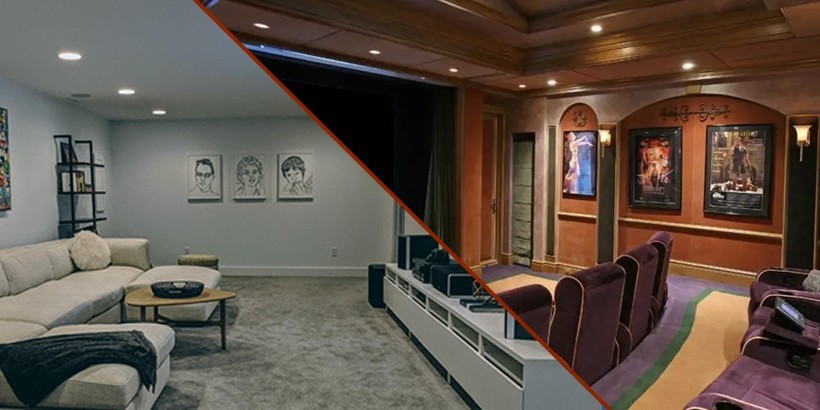
Home Theater vs Media Room: Which one do you actually need?
Last updated: May 2026
Home Theater vs Media Room: Which One Do You Actually Need?
The question comes up on almost every new construction project we work on in South Florida. The architect has labeled a room “home theater” on the plans. The interior designer is asking about seating and finishes. And the homeowner, when we sit down to talk through it, describes what is actually a media room. Getting this distinction right before construction starts matters because the two rooms are built differently, cost differently, and serve different purposes. Changing direction after framing is expensive.
This guide covers the practical differences between a true home theater and a media room, what each costs in South Florida, and how to decide which one actually fits the way you live.
What a home theater actually is
A home theater is a single-purpose room. It exists for one thing: cinema. Every design decision in a true home theater is made in service of that goal, starting with the room itself. Light is controlled or eliminated. Walls are treated acoustically so sound behaves predictably and does not bleed into the rest of the house. Seating is arranged at specific distances and heights from the screen, calculated so every position delivers the same viewing angle and sound field. Nothing in the room competes with the image or the audio.
The technical requirements follow from that premise. A projector throwing a 120-inch or larger image onto a tensioned screen performs correctly only in a room that can achieve near-total darkness. Dolby Atmos requires ceiling channels, specifically placed relative to the listening positions, that deliver overhead sound accurately. Acoustic isolation, meaning the room does not broadcast sound to adjacent spaces, requires decoupled wall construction and a floating ceiling. None of those elements are add-ons. They are fundamental to the room working as designed.
The result is a space that delivers a genuinely different experience than any other room in the home. It is also a space that is used for one thing, sits empty when not in use, and requires a meaningful construction investment to do correctly. For a family that watches movies three or four times a week and wants a dedicated space for it, that investment is justified. For a family that watches movies occasionally and primarily uses the room for sports, gaming, and casual entertaining, it is probably not.
What a media room actually is
A media room is a multi-purpose entertainment space. It handles movies, sports, gaming, casual entertaining, and background music. The seating is comfortable and often flexible. The display is large, typically a premium 85-inch or larger OLED or QLED panel rather than a projector, because the room is not dark enough for a projector to perform well. The audio is good but not calibrated to reference standards because the room is not acoustically treated to a level where calibration is meaningful.
The media room does not require acoustic isolation, decoupled wall construction, or ceiling channel speaker placement calculated to the inch. It does benefit from thoughtful design: a recessed display, in-ceiling Sonance speakers, good acoustic absorption on the back wall to reduce echo, and lighting control so the room can shift from bright entertaining to dim movie-watching with a single scene activation. Those elements make a media room genuinely pleasant without the construction scope of a dedicated theater.
Most homes in South Florida that call themselves “home theaters” on the floor plan are actually media rooms. That is not a criticism. A well-designed media room in a Coral Gables or Weston home delivers an excellent entertainment experience and serves the household far more hours per week than a dedicated theater would. The mistake is building a media room to theater construction standards, or building a theater when what the client actually wants is a media room.
The design differences that matter most
Light control is the first dividing line. A home theater requires complete darkness when in use. That means no windows, or windows with motorized blackout shades that seal fully at the frame. A media room benefits from light control but does not require blackout conditions. A partially darkened media room with a large OLED panel is entirely functional. The same room with a projector is not, because projector contrast ratios collapse in ambient light.
Acoustic treatment is the second. A dedicated theater requires bass traps at the corners, broadband absorption on side and rear walls, and diffusion on the back wall behind the seating. If acoustic isolation from adjacent rooms is a goal, the construction scope expands significantly: decoupled walls, a floating ceiling, and an isolated mechanical room for the equipment rack. A media room benefits from some absorption on the back wall and possibly a fabric-covered panel or two, but does not require the full treatment package. The cost difference between treating a media room and properly treating a dedicated theater is significant, often $15,000 to $40,000 on a 250-square-foot room.
Seating geometry is the third. A home theater places every seat at a calculated distance from the screen and at a specific height so the sightlines and sound fields are consistent. Tiered risers are standard. A media room seats people comfortably without the geometric precision, which is why sectional sofas, recliners, and flexible seating arrangements work in media rooms and do not work in theaters.
What each room costs in South Florida
A well-designed media room in a South Florida home typically runs $25,000 to $75,000 installed. That covers a premium 85-inch or larger display, in-ceiling Sonance speakers driven by a multi-channel amplifier, a streaming source, basic lighting control through a Lutron or Crestron integration, and comfortable seating. Acoustic work at this level is limited to one or two panels and does not add materially to the cost. The room can usually be completed in two to four weeks without affecting other areas of the home.
A dedicated home theater starts at $50,000 for a mid-range build in a 200 to 250-square-foot room with a Sony laser projector, 7.1 surround audio, basic acoustic treatment, and tiered seating for six to eight. A high-end dedicated theater with full acoustic isolation, reference-grade Dolby Atmos configuration, premium seating, custom millwork, and a complete Crestron integration runs $100,000 to $200,000. Ultra-luxury builds with reference projection, custom fabrication, and a full acoustic room-within-a-room construction run $200,000 to $300,000 and above in Key Biscayne, Palm Beach, and similar markets.
The cost difference between a media room and a dedicated theater is real, and it is primarily driven by acoustic construction and display technology. If the display budget alone is the deciding factor, a projector-based theater requires a higher display investment than a media room’s flat panel, but delivers a meaningfully larger image. If the construction budget is the constraint, a media room delivers 80 percent of the experiential value at 40 to 50 percent of the cost of a dedicated theater.
The display decision: projector vs flat panel
Display technology is where the two rooms diverge most visibly. A home theater is almost always built around a projector: a 4K laser unit like the Sony VPL-XW5000 or VPL-XW7000 throwing a 120-inch or larger image onto a tensioned screen in a darkened room. The image size and immersion available from a projector at that throw distance cannot be replicated by any flat panel at any current price point.
A media room is almost always built around a premium flat panel: an 85-inch or 98-inch OLED or QLED that delivers excellent contrast and color accuracy in normal ambient light. For rooms that cannot achieve consistent darkness, or for clients who want the display ready without a 90-second warm-up and alignment process, the flat panel is the practical choice. Laser TVs, including the Hisense L9 series, are a middle-ground option for screens around 100 to 120 inches in rooms where full darkness is achievable but ceiling clearance or throw distance limits a traditional projector.
How to decide which one is right for your home
Three questions settle the decision for most clients we work with in South Florida.
First: is the room dedicated or shared? If the room will be used for sports, gaming, family gatherings, and homework alongside movies, it is a media room. A dedicated theater that doubles as a homework room is neither a good theater nor a good homework room.
Second: can the room achieve full darkness? If the room has windows that cannot be addressed with motorized blackout shades, or if the architectural design of the home makes a dark room impractical, a projector-based theater will underperform. Build the media room instead and invest the acoustic budget in audio quality rather than light control.
Third: how often will the room be used for its primary purpose? A dedicated theater that sees two movie nights per week justifies its construction cost. One that sits dark for three weeks at a time and comes alive for the Super Bowl is a media room dressed as a theater.
We work through these questions during the design consultation for every home entertainment project we take on in Miami-Dade and Broward. The goal is to build the room that fits the household, not the room that looks most impressive on the floor plan. Reach us at (305) 791-7001 for Miami-Dade projects or (954) 251-0600 for Broward, or share your floor plans through our contact page.
You might also enjoy


